
- 0 Comment
Key Takeaways
A roof pipe boot seals plumbing vent pipes penetrating your roof. When the boot fails, water can leak around an otherwise intact vent pipe.
A cracked or leaking pipe boot is usually a localized problem. A failed pipe boot can usually be repaired without replacing all shingles, as long as surrounding materials and deck are still sound.
Rocky River homeowners should watch for ceiling stains near bathrooms, attic moisture around vent pipes, and leaks that appear only during heavy rain or snowmelt.
Northeast Ohio’s sun, snow, ice, and freeze thaw cycles are hard on rubber roof boots and sealants; regular inspections of all roof penetrations catch problems early.
If you notice water leaking around a vent pipe, schedule a professional roof inspection with Phoenix Roofing & Solar. Emergency crews respond to Rocky River roof damage the same day when urgent repairs are needed.
Introduction: Why Roof Pipe Boot Leaks Matter in Rocky River
Every Rocky River home has plumbing vent pipes that extend through the roof to release sewer gases. Each of those penetrations must be sealed with flashing to keep water out. The flashing assembly around the pipe is commonly called a pipe boot, roof boot, plumbing vent boot, or pipe flashing.
In many Rocky River roof leaks, the pipe itself is fine. The boot, seal, or roof pipe flashing around it has deteriorated, creating a small but persistent roof penetration leak. Even a slow pipe boot roof leak can damage shingles, underlayment, roof decking, insulation, and interior ceilings if it goes unaddressed through multiple Ohio winters.
Phoenix Roofing & Solar provides roof repair in Rocky River, Ohio and across Cuyahoga County, with a focus on diagnosing leaking roof vents and other roof penetrations before water damage spreads.
What Is a Roof Pipe Boot?
Plumbing vents are vertical pipes tied into a home’s drain system. Rocky River building practice routes them through the roof so gases vent safely outdoors. Without a boot or pipe flashing over that hole, water would follow the pipe straight into the attic every time it rained or snowed.
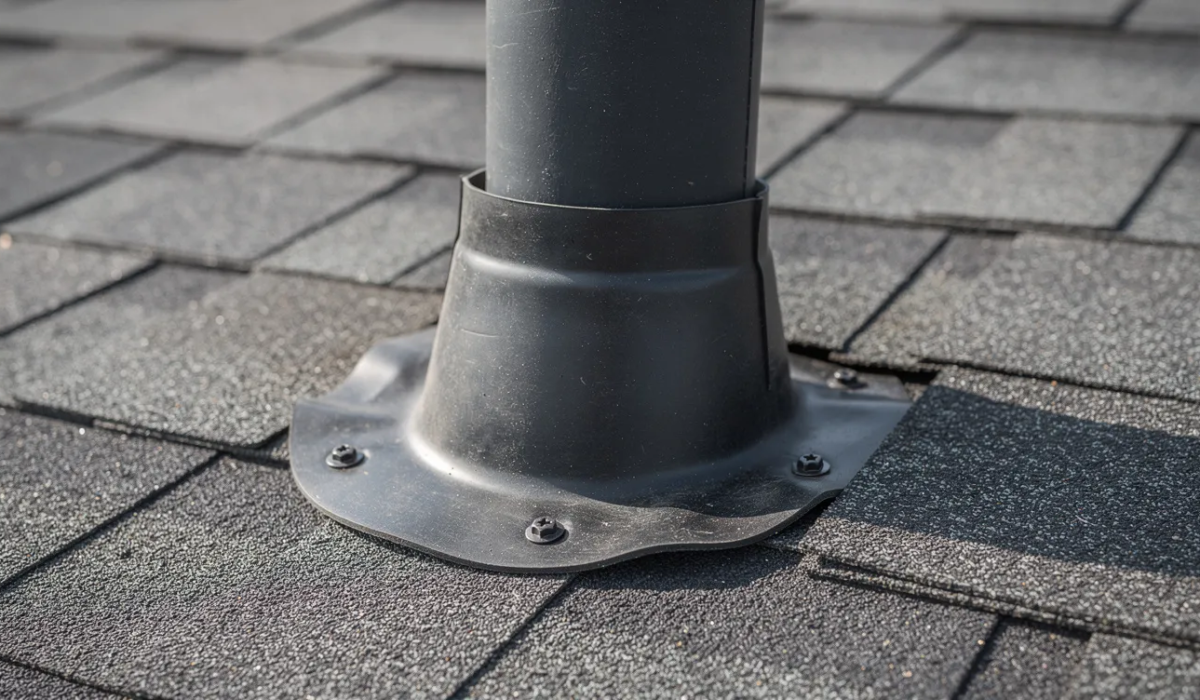
A typical pipe boot assembly has three parts:
A flat base (metal or plastic) that sits on the roof surface
A flexible collar (rubber or neoprene) that wraps tightly around the pipe
An upper flange that tucks under the shingles on the upslope side
Proper integration of pipe boots with shingles is critical for leak prevention. Water flowing down the roof runs over the upper flange, across the base, and onto the shingles below, then toward the gutters. When any part of that sequence breaks down, water finds its way inside.
What Does a Roof Pipe Boot Look Like on Rocky River Roofs?
When Rocky River homeowners look up at their roof, they typically see several short pipes with a metal or plastic base and a rubber ring. That whole assembly is the pipe boot.
On most asphalt shingle roofs in Northeast Ohio, the standard configuration is a black or gray rubber collar bonded to a galvanized steel or aluminum base. Older Rocky River homes built between the 1950s and 1980s may have all-metal pipe flashing with a formed collar, while newer installations often use neoprene plumbing vent flashing designed for broader temperature ranges.
Some roofs use “high-boot” or extended collars when a plumbing vent sticks up higher than usual. Not all roof vent flashing looks the same; some products are all metal, some combine a metal base with a rubber collar, and some are entirely plastic. Rocky River homeowners should not assume every roof uses the same type or has the same lifespan.
Why Do Roof Pipe Boots Leak on Rocky River Homes?
Roof pipe boots are one of the most common points of failure on Rocky River roofs because they combine a moving part (the pipe), a flexible material (rubber), and constant exposure to Lake Erie weather. In the Cleveland area, pipe boot failures account for roughly 28% of reported roof leaks. A leaking roof pipe boot is common in regions with freeze thaw cycles, and Rocky River gets about 80 to 100 of those cycles every winter.
Here are the primary causes:
Cracked rubber. UV exposure dries out and embrittles the collar over years of sun and weather.
Dried or separated seals. The collar loses grip on the pipe surface, creating a gap.
Loose fasteners. Nail or screw holes in the metal base widen from thermal movement and vibration.
Improper installation. Failing to slide the upper flange under shingles, skipping ice and water shield membranes around vent penetrations (recommended in cold climates like ours), or over-nailing the base all create long-term leak paths.
Wind and storm damage. Wind gusts in Rocky River exceed 40 mph regularly; wind gusts off Lake Erie regularly exceed 40 mph, driving rain sideways under shingle edges and into flashing gaps. Falling branches from mature trees can physically crack a collar or dislodge a base.
Previous poor repairs. Thick smears of roofing cement over worn rubber may hide cracks but do not restore flexibility, and they can trap moisture and conceal rust.
Damaged shingles. Cracked or curling shingles immediately above or beside a pipe boot can let water in, mimicking a pipe boot leak even when the collar is still intact.
Why the Rubber Around a Plumbing Vent Can Crack
Most modern pipe boots in Rocky River use a flexible rubber or neoprene collar that hugs the vent pipe. Over time, this material ages under outdoor exposure.
Daily sun exposure, especially on south- and west-facing slopes, drives UV breakdown. The rubber loses plasticizers, dries out, and develops hairline cracks right where it bends around the pipe. On high-exposure slopes, visible cracking can appear as early as years six to eight.
Winter temperatures in Rocky River swing from below zero to above freezing, sometimes within the same week. That collar may sit below 0°F overnight, then climb past 120°F under direct summer sun. Each cycle causes expansion and contraction that slowly fatigues the rubber. When water seeps into existing surface cracks and freezes, it expands roughly 9%, widening those cracks season after season.
Different rubber roof boot products age at different rates depending on material quality, color, slope orientation, and attic ventilation beneath the roof. No single fixed lifespan applies to every installation.
7 Signs Your Roof Pipe Boot May Be Leaking
Rocky River homeowners often discover a pipe boot roof leak through indoor symptoms first, not by looking at the roof. Common signs of a pipe boot leak include ceiling water stains and musty odors. Here are seven specific things to watch for:
Water stain near a bathroom or plumbing wall. A tan or brown ring on the ceiling, typically appearing after heavy rain or snowmelt, often directly below a plumbing vent above.
Attic staining around the vent pipe. Dark marks or damp insulation where the pipe passes through the roof deck, sometimes with rusty nail heads nearby.
Damp roof decking. Moisture or soft spots on the underside of the deck around the vent penetration, visible during an attic inspection.
Cracked rubber around the pipe collar. Splits, gaps, or hardened rubber that no longer flexes or grips the pipe.
Visible gaps around the vent. Daylight or separation between the boot and the pipe surface.
Deteriorated surrounding shingles. Missing, curled, or cracked shingles beside the pipe flashing, with exposed fasteners that have backed out.
Leaks that appear only during heavy rain or rapid snowmelt. Especially on the windward side of Rocky River homes during lake storms, intermittent leaks point to a roof penetration problem.
Stay off the roof. Look from the ground with binoculars, and call for a professional roof inspection in Rocky River if any of these signs appear.
Why Does My Ceiling Leak Near a Bathroom Vent?
A brown stain appears on the ceiling near a bathroom light or fan. Most homeowners assume the fan itself is leaking. That is one possibility, but ceiling stains near a bathroom can come from several sources:
A roof vent pipe leak around the plumbing vent boot
Water leaking around a separate bathroom exhaust roof vent
Condensation inside the exhaust duct
Another roof leak that traveled along framing before showing up at the bathroom
The plumbing vent is part of the drain system and is usually just a straight pipe. The exhaust vent is tied to the fan and has a hood or louvered cap. Phoenix Roofing & Solar investigates by checking the roof directly above and uphill of the stain, examining both the plumbing vent flashing and the bathroom exhaust vent flashing, and tracing moisture in the attic to find the exact path. Correctly identifying the source prevents repeated patches.
Plumbing Vent vs. Bathroom Exhaust Vent: What’s the Difference?
Rocky River homeowners often confuse these two roof penetrations because both sit near bathrooms and extend through the roof with some type of vent flashing.
Feature | Plumbing Vent | Bathroom Exhaust Vent |
|---|---|---|
System | Part of the plumbing/drain system | Part of the HVAC/ventilation system |
Purpose | Balances drain pressure so water flows properly | Removes humid air from the bathroom |
Appearance on roof | Straight pipe with a pipe boot | Hooded or louvered cap with ductwork below |
Flashing type | Pipe boot / plumbing vent flashing | Roof vent flashing assembly around the exhaust hood |
Both penetrations can leak if their flashing fails, but the repair details differ. A thorough roof inspection in Rocky River evaluates each component separately.
How Can You Tell If a Pipe Boot Is Leaking?
Confirming a pipe boot leak usually requires a roofer in Rocky River, Ohio to inspect both the exterior and the attic. Here is what a professional checks:
Exterior: Inspect the roof collar for cracks or deterioration to identify leaks. Pull gently on the boot to test separation from the pipe. Check for exposed or rusted fasteners. Verify the upper flange sits properly under the shingles.
Surrounding materials: Evaluate shingles and underlayment for storm damage, nail pops, or improper overlaps that might allow water in near the boot.
Attic: Examine deck around the vent pipe for staining, moisture, softness, or delamination.
The closest roof penetration to a ceiling stain is not always the source. Water can travel before dripping through, so experienced Northeast Ohio roof repair contractors trace moisture patterns rather than guessing.
Can Water Travel Away From a Leaking Pipe Boot?
Yes. Water from a roof pipe boot leak can travel along building components before dripping through the ceiling some distance away from the pipe.
Water follows the underside of roof decking, runs along rafters, clings to nails, and even follows plumbing or electrical lines. A stain on one side of a hallway ceiling might originate from a pipe boot two or three rafters over. This is why two Rocky River homes with similar stains might have completely different leak sources; one could be a plumbing vent flashing problem, while another traces back to a valley or chimney flashing issue.
A step-by-step moisture trace is more reliable than guessing based on where the stain appears.
Can a Leaking Pipe Boot Damage Roof Decking?
Yes. Repeated water intrusion around a roof penetration can damage OSB or plywood deck around the vent over several Rocky River seasons.
Early stage: Staining and intermittent dampness in the attic around the vent pipe, sometimes with light surface mold if the area stays humid.
Advanced stage: Delamination of plywood, soft or spongy deck when walked on, and in severe cases, structurally compromised wood around the penetration.
Staining alone does not always mean the deck must be replaced. When Phoenix Roofing & Solar performs roof repair around a leaking pipe boot, we inspect the exposed deck and only recommend replacement where the wood has actually deteriorated.
Can a Pipe Boot Be Replaced Without Replacing the Whole Roof?
Yes. In many Rocky River homes, a failed or cracked pipe boot can be replaced as a localized roof repair while the rest of the roof remains serviceable.
Localized repair works when:
Surrounding shingles are still flexible, not brittle
There is no widespread storm damage across the roof
Any deck damage is limited to a small area near the penetration
If the roof is already near end of life, with curling or missing shingles and multiple leaks, then a pipe boot issue may signal that a broader roof replacement conversation is worth having. Phoenix Roofing & Solar does not automatically recommend full replacement for a single leaking roof vent. We explain repair vs. replacement options based on actual roof condition, so homeowners can afford the solution that fits.
How Roofers Replace a Failed Pipe Boot in Rocky River
This section describes the professional process; it is not a DIY guide. Homeowners should avoid climbing onto roofs, especially on steep pitches.
Inspect the area from inside (attic) and outside (roof surface). Confirm the leak source.
Carefully loosen or remove shingles around the old boot.
Detach the failing flashing assembly and expose the deck around the plumbing vent penetration.
Inspect the deck for staining, softness, or rot. If small areas are compromised, cut out and replace those sections.
Slide the new pipe boot down over the vent pipe. Tuck its upper lip beneath the upslope shingles; lay its lower flange on top of the downslope shingles.
Fasten and seal where appropriate using compatible materials.
Reinstall or replace shingles around the boot. Check shingle edges and exposures for proper coverage.
Skilled installation ensures the repair integrates with the rest of the Rocky River roof system and sheds water correctly.
Pipe Boot Repair vs. Pipe Boot Replacement
Rocky River homeowners sometimes ask if a leaking roof vent can just be “sealed up” instead of replacing the boot. The answer depends on what has failed.
A minor repair may be appropriate when resealing a small gap between the boot’s metal base and the shingle, tightening a fastener, or applying compatible sealant to a small, accessible crack. When the rubber collar is cracked all the way around or has pulled away from the pipe, smearing more sealant over deteriorated materials is a short-term patch at best.
Repeated patches with roofing cement build up thick layers that make future proper repairs harder. They can trap water and conceal rust or decay beneath. Phoenix Roofing & Solar evaluates each leaking roof vent individually and explains when pipe boot replacement is the more reliable long-term fix.
Why Caulk Isn’t Always the Best Fix for a Leaking Pipe Boot
Many DIY attempts in Rocky River involve squeezing caulk around a vent pipe. Using caulk or sealant alone is often a temporary fix for pipe boot leaks. Here is why:
Caulk and roofing sealants age and crack under lakefront exposure, sun, snow, and freeze thaw cycles, often failing again within one to two seasons.
If the rubber collar itself is torn or has large gaps, caulk does not restore the strength or flexibility of the original boot.
Heavy smears of roofing cement over flashing and shingles hide problems from future inspections, making it harder to find where water is actually entering.
Proper roof repair focuses on fixing or replacing the failed component, not coating everything in sealant and hoping for the best.
Pipe Boot Leak vs. Condensation Around a Vent Pipe
Moisture around a vent pipe in a Rocky River attic does not always mean rainwater is coming through the roof. In winter, warm humid indoor air can escape into an under-ventilated attic and condense on cold metal piping, sheathing, or nails. Older roofs often lack proper ventilation, causing moisture issues that mimic leaks.
Condensation tends to show up as widespread frost or dampness across larger attic areas. A pipe boot roof leak is usually more localized, centered on the penetration. Phoenix Roofing & Solar checks attic ventilation, insulation, and air sealing when investigating suspected leaks. Correctly identifying the moisture source prevents unnecessary roof work and addresses the real problem, whether that involves roofing, ventilation, or both.
Can Snow and Ice Cause Problems Around Plumbing Vents in Rocky River?
Rocky River experiences heavy snow loads from lake effect, with drifts that can pile up around vent pipes and submerge the pipe boot for days. Heavy snow loads stress roof structures, especially on shallow pitches where snow sits longer before sliding off.
When snow melts during a sunny afternoon and refreezes at night, water seeps into hairline openings around a cracked pipe boot, then freezes and expands, gradually widening the gap. Ice dams form when attic heat melts snow on roofs, and the resulting meltwater can back up behind the dam and pool around vent penetrations. Ice buildup can also lift shingles slightly near penetrations, creating new leak paths once thawing begins.
Regular roof inspections, especially after severe winters or major storms, help catch developing pipe boot problems before they escalate into a larger roof leak repair.
Does a Leaking Pipe Boot Mean I Need a New Roof?
No. One leaking pipe boot on an otherwise healthy Rocky River roof does not mean a full roof replacement is required. Many Northeast Ohio roof repairs involve replacing one or more pipe boots, resealing localized flashing, or swapping a small section of damaged shingles while leaving the overall roofing system intact.
Roof replacement becomes a more appropriate conversation when signs of widespread aging are present: brittle, curled, or missing asphalt shingles across large areas; multiple active leaks; and extensive water damage to the deck.
Schedule a professional roof inspection to get an honest assessment of whether your situation calls for pipe boot replacement, broader repairs, or planning for a future full replacement.
Pipe Boot Repair vs. Roof Replacement: How to Decide
Factor | Localized Repair Makes Sense | Broader Roof Work May Be Appropriate |
|---|---|---|
Pipe boots | One failed boot | Multiple boots and flashings failing |
Shingles | Still flexible around the vent | Widespread deterioration across slopes |
Deck condition | Limited or no damage | Soft or rotted in multiple locations |
Leak count | Single, isolated leak | Several active leaks |
Overall roof age | Mid-life; normal wear for age | Near or past expected lifespan |
Phoenix Roofing & Solar walks Rocky River homeowners through these factors, including cost, remaining roof life, and risk of future leaks, to help you plan whether a spot repair or a roof replacement project makes more sense for your property.
Should Pipe Boots Be Checked During a Roof Inspection?
Yes. Any thorough roof inspection in Rocky River should include close evaluation of all plumbing vents, pipe boots, and roof vent flashing.
An inspector checks for:
Cracked or shrinking rubber collars
Gaps between the boot and the pipe
Rusted or loose fasteners in the metal base
Shingles that no longer lie flat around the penetration
Attic moisture, staining, or daylight around each vent penetration
Phoenix Roofing & Solar recommends inspections for Rocky River homeowners after storms or once a roof is past its first decade. Treat pipe boot inspection as part of proactive maintenance, like cleaning gutters and debris removal from valleys, to protect property and extend the life of Rocky River roofs.
Other Roof Penetrations Rocky River Homeowners Should Know About
Pipe boots are just one type of roof penetration. Every penetration needs proper flashing to stop leaks and restore protection to the roof surface.
Other common penetrations on Rocky River roofs include:
Bathroom and kitchen exhaust vents with their own hood assemblies
Attic vents and ridge vents tied to attic ventilation
Furnace or water-heater B-vents requiring metal flashing rated for heat
Skylights with step flashing and sill pans
Chimneys with step flashing, counter-flashing, and sometimes a cricket
HVAC lines, satellite mounts, and other add-ons sometimes create small penetrations that were not part of the original roof design. Algae growth appears on north-facing slopes due to moisture and can hide flashing problems from casual observation. Mature trees in Rocky River drop leaves that clog gutters and valleys, creating conditions that worsen water backup around penetrations. Rocky River’s clay-heavy soil shifts with moisture changes, which can affect the foundation and subtly alter framing alignment; in some cases, this movement even changes the fit of a pipe boot over time, though excavation or structural work is rarely needed for a roofing issue alone.
During any roof repair or roof inspection in Rocky River, Phoenix Roofing & Solar reviews all penetrations together. Correcting multiple small issues at once is often more efficient for homeowners.
Serving Rocky River and Surrounding Northeast Ohio Communities
Phoenix Roofing & Solar is a roofing company serving Rocky River, Ohio and nearby Cuyahoga County communities along the lake, including Lakewood, Fairview Park, Bay Village, Westlake, North Olmsted, Cleveland, and surrounding communities across adjacent counties. Whether you live near Rocky River Reservation, along Center Ridge Road, or in one of the older neighborhoods closer to the lakefront, we handle roofing services for most homes and businesses in our service area.
Rocky River roofs face moisture, wind, snow, and freeze thaw cycles that wear out materials faster than in milder climates. Our crews regularly perform Northeast Ohio roof repair for leaking roof vents, pipe boot replacement, flashing repair, and storm damage on residential and commercial properties. Rocky River roofing services we provide include everything from emergency calls (emergency roofing services include tarping and leak detection equipment; most emergency repairs are completed within 24 hours of assessment, helping prevent secondary water damage) to scheduled inspections, maintenance, and roof replacement. We also help homeowners navigate the claims process for storm-related roof damage and offer financing options when needed.
If you suspect a roof pipe boot leak or any roof penetration leak on your Rocky River home, contact Phoenix Roofing & Solar for a prompt, professional assessment and clear repair options. We inspect, we explain what we find, and we let you decide.
Frequently Asked Questions
How often should Rocky River homeowners have pipe boots inspected?
For most Rocky River roofs, a professional inspection every one to two years is reasonable. Once the roof passes its first decade, annual inspections help catch pipe boot wear before it becomes a leak. After major storms, schedule an extra check; roofing contractors can map developing issues across all penetrations and give you a plan for the coming seasons.
Can I see a cracked pipe boot from the ground?
Sometimes. Large cracks or gaps may be visible with binoculars, especially on lower-slope sections. Smaller failures, such as hairline cracks on the collar lip or partially lifted shingle edges near the boot, usually require a roofer on the roof to confirm. Ground checks are helpful but not a substitute for a full roof inspection.
Is it okay to wait until spring to fix a small pipe boot leak?
Even “small” leaks can get worse through Rocky River’s winter freeze thaw cycles. Water that enters a crack, freezes, and expands can turn a minor gap into a serious opening by March. Have the area evaluated promptly so a roofer can determine whether temporary protection (such as tarping) or permanent repair is needed before freezing weather sets in.
Will my homeowner’s insurance cover pipe boot leak repairs?
Coverage depends on the policy and whether the damage stems from sudden storm damage or gradual wear. Wind and hail damage are generally covered; long-term deterioration from aging rubber typically is not. Contact your insurer and ask about your specific situation. Phoenix Roofing & Solar can document roof conditions with photos and inspection notes to support the claims process when storm damage is involved.
Can multiple leaking pipe boots be upgraded during one visit?
Yes. It is often efficient to replace several aging pipe boots on the same Rocky River roof at once, especially when they are the same age and showing similar wear. Addressing them together reduces future leak risk, cuts service visits, and lets roofing contractors protect your property more cost-effectively than fixing one boot at a time.